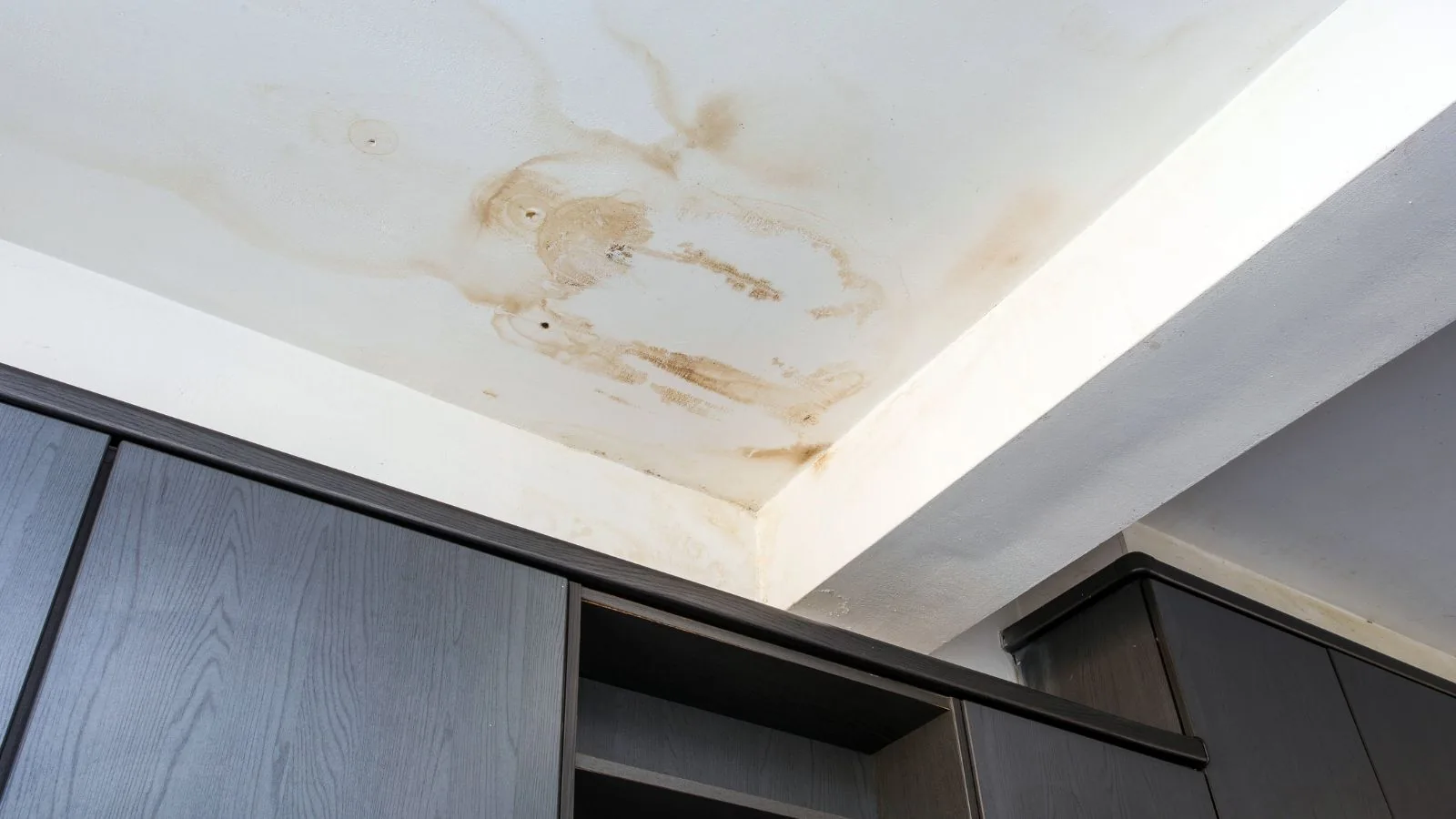
Water under the sink or across the kitchen: first steps
A kitchen leak is urgent because cabinets and floors absorb water fast. If the water is coming from under the sink, close the shutoff valves on the supply lines. If you cannot find the source, close the main valve.
Empty the cabinet under the sink, set out towels and a bucket, and photograph the damage. Turn off power to the kitchen circuit if water is near outlets or an appliance. Our line is open 24/7 and a same-day response is offered when a crew is available.
Why kitchens take the worst of a leak
A kitchen has supply lines, drain lines, a dishwasher, often a refrigerator ice maker and a sink, all within a few feet. Any of them can leak, and water runs under cabinets that are fixed to the floor and walls.
Particleboard cabinet bases swell when wet and do not return to shape. Solid wood and plywood fare better. The toe-kick, the thin panel at the base of the cabinets, hides water behind it.
Cabinet materials and how they handle water
The material decides whether a cabinet can be dried.
| Type | How it reacts | Likely outcome |
|---|---|---|
| Particleboard or MDF | Swells, crumbles, does not recover | Replace |
| Plywood box | Resists better, can dry | Often dried if caught early |
| Solid wood | Can warp but often dries | Dry and assess |
| Laminate or thermofoil face | Peels at edges | Replace the face or the cabinet |
What the crew checks in a kitchen
The visible puddle is only the start:
- The cabinet base and toe-kick, where water collects.
- The subfloor under vinyl, laminate or tile.
- The wall behind the sink and dishwasher.
- The ceiling below, if the kitchen is on an upper floor.
- The supply and drain connections, to find the source.
If the leak started with an appliance, our appliance leak water damage page explains the sources in detail.
Kitchen water damage gets worse behind the cabinets
Call day or night.
How the kitchen is dried
The crew extracts water, removes toe-kicks and lower panels to open the cavity, and sets air movers and dehumidifiers. Drying mats may be used on hardwood. Water in the wall behind the sink is handled like any wall and drywall loss.
If cabinets must be removed, the crew labels and stores them so a contractor can reinstall them. Countertops usually come off only when the cabinet base is replaced.
Dishwashers, countertops and the toe-kick: details that get missed
A dishwasher sits in a cavity with a supply line, a drain line and an electrical connection. When it leaks, water collects under the unit and moves toward the lowest point. Pulling the dishwasher out is often the only way to see how far it spread.
Countertops usually stay in place, unless the cabinet base under them has to go. Laminate counters with a particleboard core can swell at seams when water gets in from below. Stone and solid surface are rarely harmed by water, though the cabinets beneath may be.
The toe-kick is the recessed panel at the floor. It hides the bottom of the cabinets and traps water behind it. Removing it lets air in and shows whether the cabinet base is wet. If you smell something musty after a leak, check behind it.
Cost and insurance for kitchen water damage
Price depends on how many cabinets are wet, the flooring type, whether the wall behind was reached, and how long the area stayed wet. Cabinet replacement is often a major part of the cost.
Sudden leaks under the sink or from an appliance line are often covered by homeowners insurance, while slow leaks over time often are not. Check your policy or ask your insurer. Want your real number? Call (844) 950-6900 and we will explain the scope and price before work starts.
What to do before help arrives
Kitchen leaks involve water and electricity, so go in this order:
- Shut off the water at the fixture valve or at the main.
- Turn off power to the kitchen at the breaker if the floor is wet and you can reach the panel safely.
- Do not use the dishwasher, disposal or oven until a technician checks them.
- Empty the cabinet under the leak and set the contents on a dry surface.
- Photograph the cabinets, the floor and the source.
Standard and records
Kitchen drying follows ANSI/IICRC S500 for the structure and cabinet cavities. Ask your contractor for the daily moisture readings, since they show when cabinets and subfloor reached normal levels.
Frequently asked questions
Plywood and solid wood cabinets caught early often can. Particleboard that has swelled usually cannot.
Close the shutoff and call. Slow leaks do hidden damage, so it is better to dry the area soon.
Yes. The line is open 24/7 and a same-day response is offered when a crew is available.
We can remove and dry them. Replacement and installation are done by a contractor, and we can work with yours.
A licensed plumber repairs the leak. We dry the damage.