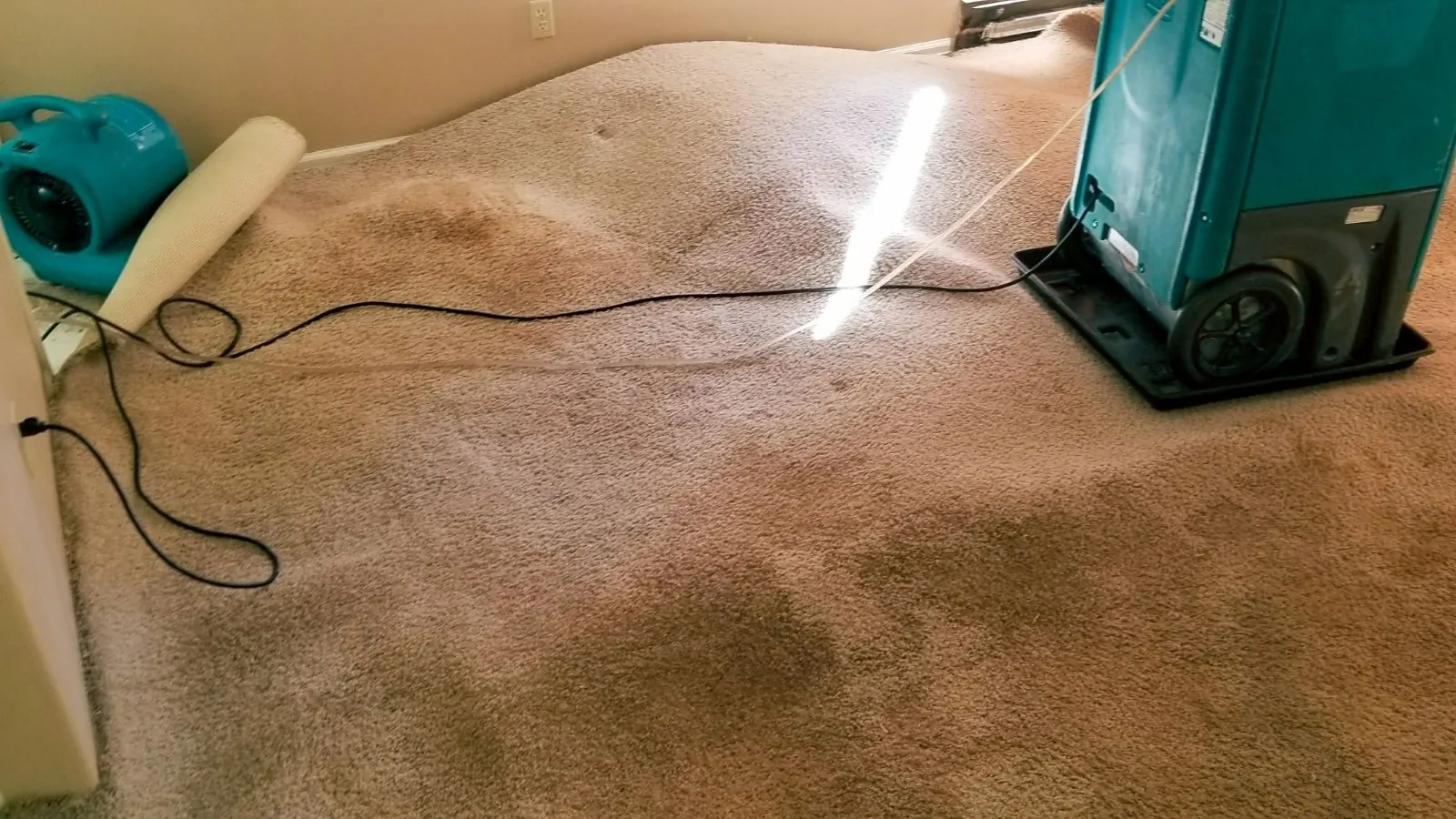
Carpet is wet: what to do right now
Wet carpet can be saved if the water was clean and it gets dried fast. Our line is open 24/7, and a same-day response is offered when a crew is available. While you wait, remove furniture and prop up wet upholstery, and lift the corners of the carpet only if you can do it without tearing.
Do not walk on it more than you have to. Avoid using a household vacuum. Open windows if the weather is dry, and turn on a fan pointed across the floor. If the water came from a drain or flood, treat it as contaminated and keep people out.
Carpet and pad: two layers, two decisions
Carpet has a top layer you see and a pad beneath it. The pad is a foam sponge. It holds water and dries slowly, so it is usually removed and replaced. The carpet itself can often be lifted, dried and put back.
If the water was clean and the carpet is in good shape, it may be saved by drying with air movers and a dehumidifier. If it was contaminated, or has been wet for days, replacement is more common.
How the water source changes the decision
The source sets the odds.
| Source | Category | Typical outcome |
|---|---|---|
| Supply line, tank leak | Category 1 | Carpet often dried, pad replaced |
| Washer overflow, dishwasher | Category 1 or 2 | Case by case |
| Flood water | Category 2 or 3 | Carpet and pad usually replaced |
| Sewage | Category 3 | Carpet and pad replaced |
How crews dry carpet
A carpet job follows a pattern:
- Extract water with weighted wands.
- Remove and dispose of the pad.
- Float the carpet on a drying system so air flows under it.
- Run dehumidifiers and air movers.
- Check the subfloor and tack strips for moisture.
If the carpet is in a basement, see our basement water damage cleanup page for the room-specific steps.
Wet carpet can grow mold within days
Call day or night.
Stairs, area rugs and carpet tiles: the cases that need different handling
Not all carpet is wall-to-wall. Area rugs can often be taken out and dried flat, then cleaned off site. Wool and natural fiber rugs need care, because they shrink or bleed when wet. Move them out of the room as soon as water stops, and unroll them to dry.
Carpet on stairs holds water on the treads and risers, and it can seep into the wood beneath. Carpet tiles can sometimes be lifted and replaced one by one, which saves the rest of the floor.
Padding is glued or stapled in some installations. If the carpet is glued down, as it often is in a basement, drying in place is harder and replacement is more likely. Tell us how your carpet was installed when you call.
Carpet, mold and odors
Wet carpet that stays wet for more than a day or two can develop a musty smell and mold growth on the back. EPA guidance says to dry wet materials within 24 to 48 hours. If carpet smells after drying, it is a sign that moisture remains.
If mold has formed, the next step is described on our mold remediation page.
Cost and insurance
Price depends on the carpet area, the water category, and how many days of drying are needed. Pad replacement and carpet restretching are separate items.
Sudden leaks are often covered by homeowners insurance, while slow leaks and neglect often are not. Check your policy or ask your insurer. Want your real number? Call (844) 950-6900 and we will explain the scope and price before work starts.
The published standard for drying carpet and pad
ANSI/IICRC S500 covers how wet carpet and pad are classified and dried or removed, based on the water category and how long they were wet. It is a published industry reference, and homeowners can ask a company whether its crews work to it.
The standard does not promise that every carpet can be saved. It gives the reasoning for when to dry and when to replace.
Frequently asked questions
Often, if the water was clean and it is dried quickly. Contaminated carpet is usually replaced.
Usually yes. Pad holds water and dries slowly.
Mold can begin within 24 to 48 hours in the right conditions. Dry it fast.
No. A flooring contractor handles that. We dry and restore.
Yes. The line is open 24/7 and a same-day response is offered when a crew is available.