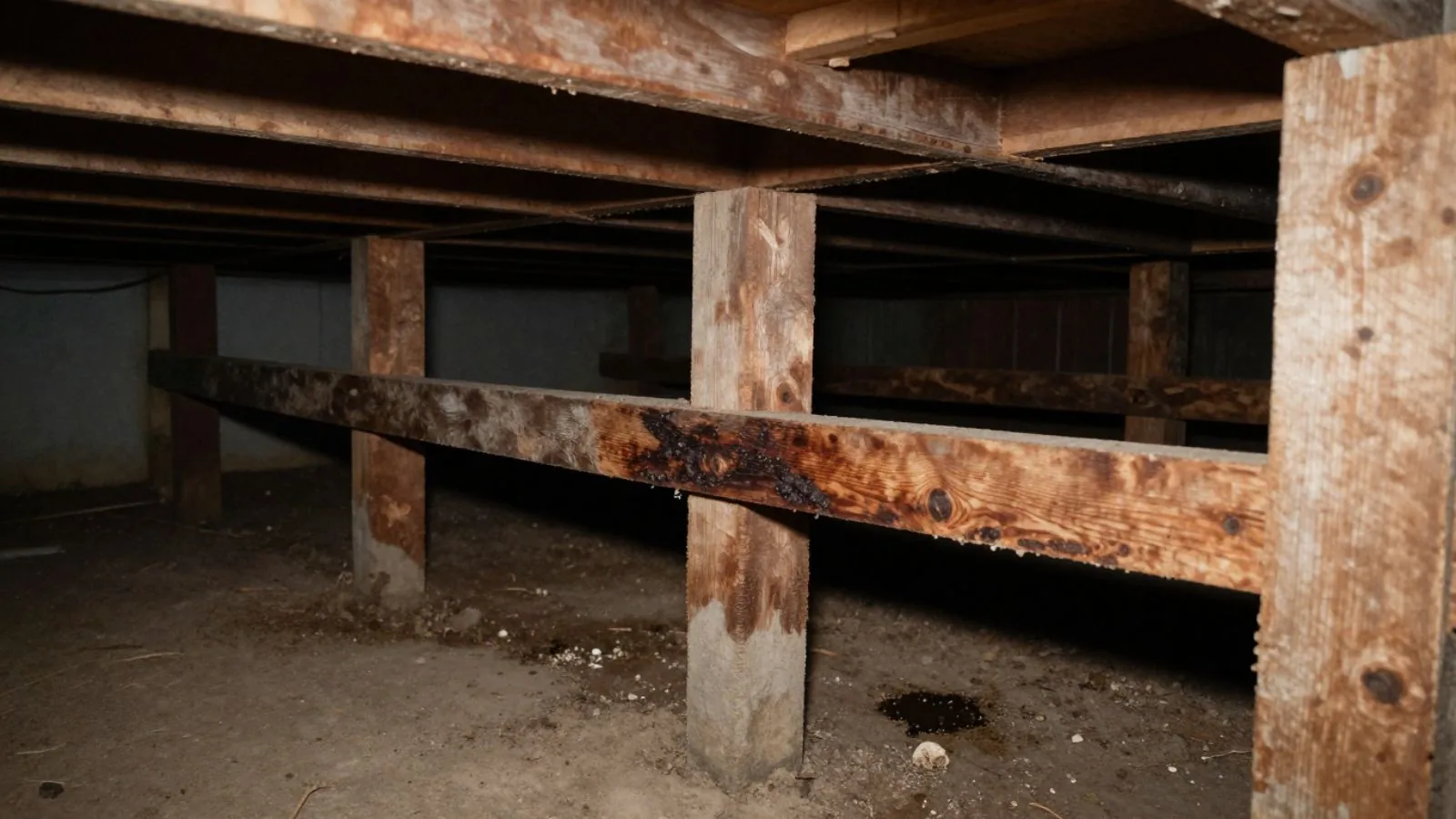
Water in a crawl space: what it means for the floor above
A crawl space is the low void between the ground and the first floor of a house. Water there wets joists, subfloor, insulation and ductwork, and the moisture rises into the living space as vapor. You may notice a musty smell, cold floors or sagging insulation.
Not every Dumont home has a crawl space, and we cannot point to a local figure for how many do. If yours has one under an addition or a rear section, this page applies. If you are not sure, ask a home inspector or look at your original plans.
What to check before anyone goes in
Water in a crawl space can be shallow and still be hazardous. Wiring, ducts and furnace parts may be low. Turn off power to the crawl space circuit before you enter, and do not go in if there is standing water near wiring.
Use a flashlight, wear boots and a mask, and look for the source: a pipe, a downspout that dumps beside the foundation, a high water table after storms, or a vent opening that lets rain in. Take photos of the water line on posts and walls.
Where crawl space moisture comes from
Finding the source decides whether the cleanup will hold:
- A leaking supply or drain pipe under the floor.
- Rain or groundwater entering through the foundation or a vent.
- A downspout or grading that sends water toward the house.
- A failed or missing vapor barrier over the soil.
- Humid air condensing on cool surfaces during summer.
Cleanup is not the same as waterproofing. If water keeps coming in, a drainage or waterproofing contractor should fix the cause.
What the crew does by condition
The work depends on what is found.
| Condition | Response | Why |
|---|---|---|
| Standing water | Pump out, then dry | Water against framing keeps it wet |
| Wet insulation | Remove and dispose | It holds water and does not dry |
| Damp joists and subfloor | Air movers and dehumidifiers | Wood needs to reach the dry standard |
| Mold growth | Containment and cleaning | Follow mold remediation practice |
The longer a crawl space stays wet, the more the floor above suffers
Call and tell us what you see.
How a crawl space is dried
The crew pumps standing water, removes wet insulation and debris, then sets small air movers and a dehumidifier in the space. Readings on joists and subfloor are taken daily.
The space is tight, so the work is slower and the equipment is chosen to fit. When the readings are dry, the crew advises whether a vapor barrier, new insulation or a sump or drainage fix should follow from a specialist.
Staying safe in a tight, wet space
A crawl space is a confined area with low clearance, uneven ground and sometimes loose insulation. Wet insulation can be heavy and sharp edges and nails are common. Boots, gloves, eye protection and a respirator mask are the minimum.
Never enter alone. Tell someone where you are going, and keep a light with you. If you smell gas, see a gas appliance sitting in water, or notice sagging joists, back out and call the utility or 911. Do not attempt to start a sump pump in standing water.
Pest droppings and animal nesting can also be present in a long-neglected crawl space, which is one more reason to let a crew handle the cleanup.
Cost and insurance
Price depends on the area, the amount of insulation, access, and how many days of drying are needed. A small space with a clear source costs less than a large one with long-term moisture.
Coverage depends on whether the water came from a sudden source or a gradual one such as groundwater or seepage. Flood and groundwater usually need separate coverage. Check your policy or ask your insurer. Want your real number? Call (844) 950-6900 and we will explain the scope and price before work starts.
Frequently asked questions
Yes. The crew pumps standing water, removes wet insulation and dries the framing. A drainage contractor handles the cause if water keeps returning.
Standing water near wiring or a rising water level should be treated as urgent. Our line is open 24/7 and a same-day response is offered when a crew is available.
Prolonged moisture can support mold growth. Drying quickly lowers the risk. If mold is found, it is cleaned following S520 practice.
No. We dry and restore. A waterproofing contractor handles drainage and barriers.
Find and stop any pipe leak, direct downspouts away from the house, and photograph the water. Do not enter if water is near wiring.